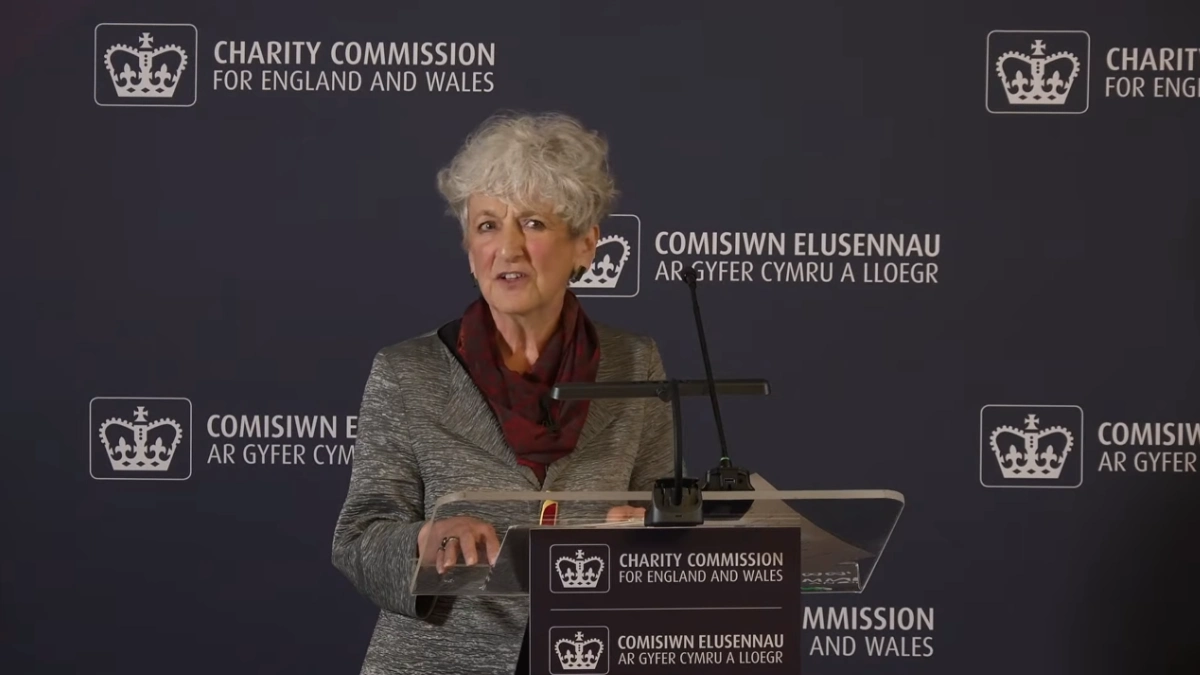

The Charity Commission held its Annual Public Meeting at the Inner Temple in London on 15 October 2026, with the Princess Royal as keynote speaker. It was the first as chair for Dame Julia Unwin, who took up the role in January. Dame Julia used her speech to argue that charities are part of the foundations of economic growth. Three things came out of the meeting that trustees can act on: a government consultation that would widen who is disqualified from being a trustee, a Commission under pressure and slower to respond, and a run of closures among the organisations that support small charities.
New to Nonprofit Voice? Our Media Hub carries regulatory news and guidance for UK charities.
A consultation trustees can respond to
In her published speech, Dame Julia asked trustees, staff, volunteers and advisers to respond to a consultation the Government published the day before the meeting. It closes at 5 pm on Wednesday 23 December 2026.
The Department for Culture, Media and Sport proposes adding several groups of offences to the list that automatically disqualifies someone from serving as a trustee or senior manager. They are offences of stirring up racial or religious hatred, or hatred on grounds of sexual orientation, under the Public Order Act 1986; racially or religiously aggravated offences under the Crime and Disorder Act 1998; offences under the National Security Act 2023 and the Official Secrets Acts; and supplying false or misleading information to the Charity Commission. A person convicted would be disqualified until the conviction is spent, unless the Commission granted a waiver.
The consultation also proposes widening the Commission’s discretionary power to disqualify people. This would cover people whose conduct or views promote or encourage violence, or racial or religious hatred, including conduct before they took up a role with a charity. It would also cover people deprived of British citizenship or excluded from the UK on public good grounds.
Two details matter for any board. The proposals would apply to offences committed before the change, after a six-month transition period. And because the false information offence concerns anything a charity tells the Commission, such as a registration application or an annual return, it is relevant to every board, not only those working in sensitive areas.
Dame Julia said the Commission supports the proposals on racial and religious hatred and on National Security Act offences, provided they are drafted precisely and with safeguards. The consultation applies to England and Wales. Responses can be made through the online survey on GOV.UK.
The Commission is busier and slower
Dame Julia was candid about the pressure on the regulator. According to her published speech, last year was another record year for registration: the Commission assessed over 11,700 applications to register a new charity, and 4,650 new charities joined the register. Its regulatory compliance caseload rose by 23 per cent, and cases involving requests for it to exercise its regulatory authority rose by 7 per cent.
She acknowledged that response times have suffered as a result. The Government has agreed an average increase of around 25 per cent in the Commission’s annual funding over the next three years, aimed at digital services and efficiency. She did not promise any immediate improvement.
For a new charity, the practical message is to apply for registration well ahead of any funding deadline and to expect questions before a decision. For an existing charity waiting on the Commission’s consent for something, such as a change to its governing document, build the wait into your plans.
Get regulatory changes as they happen. Consultations, guidance updates and funding news for UK charities, sent when there is something worth knowing. Sign up to the newsletter.
Why the Commission says charities matter to growth
Dame Julia opened her published speech by arguing that charities are a condition of economic growth, not a by-product of it. Growth depends on social trust, adaptable skills and healthy communities, she said, and charities help build all three. She cited NCVO’s estimate that donated time is worth around £18 billion a year. NCVO’s figure, from its UK Civil Society Almanac 2024, values formal volunteering in 2021 to 2022 at about 0.8 per cent of UK GDP.
She gave two examples. Taunton East Development Trust in Somerset offers advice, activities, training and volunteering to build confidence and skills locally. East Marsh United in Grimsby, a grassroots organisation that is now a registered charity, has taken on the problem of empty, run-down housing, renovating homes and letting them to local families at affordable rents.
Charities are not a silver bullet, she said, but they build the trust and skills that regeneration depends on. That argument underpins her appeal to funders in the next part of the speech: if charities are part of the economy’s foundations, so are the organisations that support them.
The organisations that support small charities
Much of the speech dealt with infrastructure, meaning the bodies that provide training, advice, trustees, volunteers and information to other charities.
The Directory of Social Change, founded in 1975, announced on 14 October that an insolvency practitioner had been appointed to manage its closure. In a joint statement, chief executive Debra Allcock Tyler and chair William Butler cited rising costs, changes in how people buy and learn, and a funding environment that sees infrastructure as unexciting. 25 jobs are being lost. Its Funds Online database remains open to existing subscribers for the time being, and the future of its publications and databases has not been decided.
Getting on Board, which helped charities recruit and develop trustees, closed last year. The Foundation for Social Improvement and Children England have also closed, and the Small Charities Coalition closed in 2022.
Reach Volunteering, which announced on 1 September that it would close, reversed that decision later in the month. Nine funders and donors came together to fund it to the end of 2028.
Dame Julia called on government, funders and foundations to fund infrastructure for the long term, describing it as cost-effective support rather than overhead. “Their loss does not affect one organisation at a time,” she said. “It weakens the capacity and resilience of the sector as a whole.”
For small charities, the gap is practical. If your board relies on any of these organisations for training, funding searches or trustee recruitment, now is the time to find alternatives, before you need them.
Independence and public trust
Dame Julia set out what she sees as the Commission’s part in keeping public trust. Its decisions should rest on evidence and the law, she said, not on popularity or pressure. That can mean registering charities with lawful purposes that some people dislike, and resisting pressure for action where there is no clear evidence, while acting firmly when the law requires it.
She condemned in the strongest terms the thuggery and intimidation that RNLI volunteers have faced, and echoed her predecessor, Mark Simms, who used last year’s meeting to condemn the growing hostility faced by some people simply for doing their lawful jobs in charities.
She ended on a positive note. Trust in charities remains high, she said, calling it “a remarkable achievement, and a precious treasure”. She pointed to what the sector has achieved, including charitable funding that she said has helped transform heart disease treatment in the UK and cut cardiovascular deaths by half over the last few decades.
What the Princess Royal said about trust and volunteers
In her keynote, the Princess Royal drew on her long involvement with Save the Children and the example of its founder, Eglantyne Jebb, to argue that public trust in charities is built on volunteers and on charities showing that money raised does what was promised.
“Just raising money was not enough,” she said. “You needed to understand what that money was going to do and who was going to be involved in delivering it.”
She wondered aloud if maintaining public trust is now the biggest challenge facing the sector, and spoke about the weight of information and regulation that falls on volunteers and trustees. “Electronic changes happen all the time,” she said, adding that this “puts more pressure on your trustees and chairs to make sure they understand all those changes.” She also observed that “charities don’t fit conveniently into one size”, and that “the Charity Commission’s job has become considerably more difficult over time.”
What to do now
Read the disqualification consultation and decide if your board wants to respond before 23 December. Check that your trustee recruitment and declaration process asks the right questions, since the proposals would apply to convictions that already exist. If you plan to register a charity or need the Commission’s consent for anything, allow more time than you would like. And if your charity depended on the Directory of Social Change or Getting on Board, find out now where you will get that support in future.
The meeting also included a panel discussion on the charity sector in divided times and a question and answer session with the Commission’s leadership. This article does not cover those sessions.